


By Abir, Founder — Guide Me Around Morocco
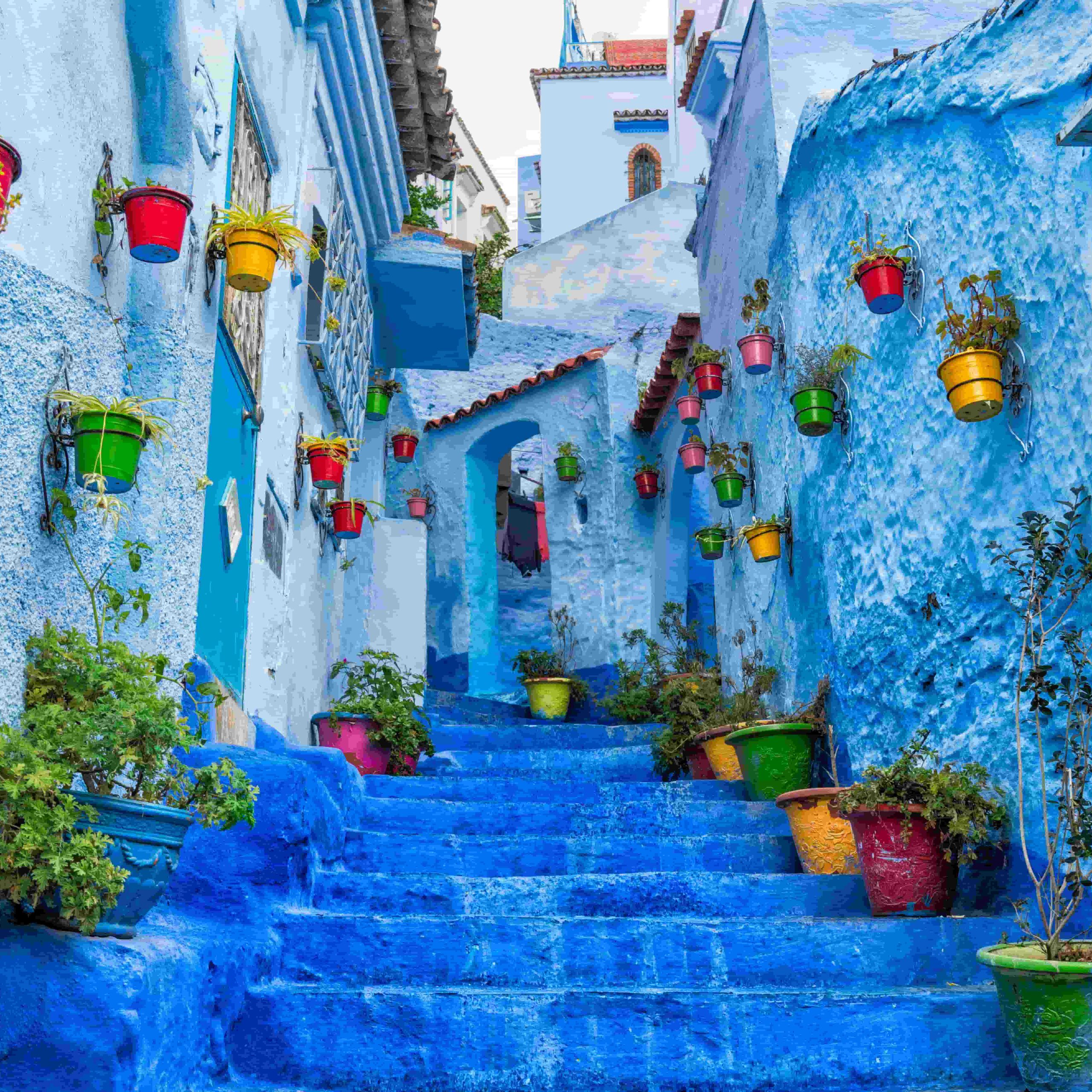
Let’s be honest: you’ve seen the photos. A cascade of blue staircases. A lone doorway drenched in cerulean. A cat curled on a powder-washed windowsill. Chefchaouen—Morocco’s “Blue Pearl”—has become a global icon, a dream rendered in Instagram hues.
But here’s what the filters don’t show: the sound of water trickling down Ras el-Ma at dawn. The scent of wild thyme and baking msemen drifting from an open kitchen window. The quiet pride in an artisan’s voice as she explains how the zigzag on her rug means “protection for the home.”
Chefchaouen is not a backdrop. It’s a living, breathing mountain town—and to truly know it, you must look beyond the blue.
The Blue: Beauty with Purpose
Yes, the color is everywhere—and yes, it’s mesmerizing. But it’s not arbitrary. The tradition of painting walls in shades of blue and white dates back centuries, blending practicality and poetry. Lime-based wash (mixed with indigo or synthetic pigment) repels insects, reflects sunlight, and keeps homes cool in summer. Spiritually, blue evokes sakīna—divine tranquility—and for many, it’s a daily reminder of faith, sky, and water: life’s essentials.
Wander deeper, and you’ll notice subtle codes: deeper blues often mark homes near mosques or those of descendants of Andalusian Muslims and Jews who settled here after the 15th-century Reconquista. White highlights aren’t just decorative—they’re structural, reinforcing corners and frames. This isn’t aesthetic whimsy. It’s cultural language, written in pigment.
Place Outa el Hammam: The Soul of the Square
At the medina’s heart lies Place Outa el Hammam, a square that pulses with unhurried rhythm. No aggressive vendors. No snake charmers. Just life: elders playing tawla (backgammon) under striped awnings, teenagers laughing over fresh-squeezed orange juice, women balancing baskets of mint and khobz on their heads.
Here stands the Kasbah—Chefchaouen’s original 15th-century fortress—now home to the Ethnographic Museum. Step inside to discover Amazigh silver jewelry, handwoven wool cloaks (afaggou), antique flintlock rifles, and photographs of the town before electricity arrived. Don’t miss the inner courtyard: a serene Andalusian-style garden with orange trees, a central fountain, and birdsong that seems to slow time itself.
Just beside it, the Grand Mosque rises with its rare octagonal minaret and green-tiled roof—a quiet testament to the town’s Andalusian roots. Though non-Muslims may not enter, sitting nearby with a glass of mint tea, listening to the call to prayer echo off the mountains, is its own form of reverence.
Ras el-Ma: Where the Town Gathers
Five minutes’ walk uphill, the medina’s calm gives way to joyful activity at Ras el-Ma—“Head of the Water.” This natural spring is Chefchaouen’s communal lifeline. Women scrub clothes on stone slabs, children chase each other through shallow streams, and locals fill plastic jugs for the day’s cooking and washing. Vendors sell warm briouats (savory pastries) and boiled eggs from wheeled carts.
Follow the path further, and the noise softens. Moss-covered rocks, walnut groves, and small waterfalls invite quiet reflection—or a spontaneous dip if the season allows. This is where families picnic on Fridays. This is where stories are exchanged, not sold.
The Spanish Mosque: Perspective, Not Perfection
Skip the crowded midday climb. Instead, set out just before sunrise. The 15-minute walk up the eastern ridge is gentle, the air crisp and scented with pine. At the top, the abandoned Spanish Mosque—built in the 1920s during the protectorate era—offers Morocco’s most breathtaking urban vista: Chefchaouen unfolding below like a spilled paintbox, the Rif Mountains rising in misty layers behind it.
There are no tickets. No ropes. Just open sky, silence, and the kind of clarity that resets your compass. Locals come here to meditate, to propose, to grieve, to celebrate. It’s not a monument—it’s a mirror.
Beyond the Medina: Into the Wild Rif
Chefchaouen is a gateway—not a terminus. Just 30 minutes away lies Talassemtane National Park, a UNESCO-recognized biosphere reserve and one of Morocco’s last strongholds of Atlas cedar forest. Hike trails where wild boar rustle in the undergrowth and endangered Barbary macaques leap between branches. Visit Akchour, where water has sculpted marble into emerald pools and natural slides—a favorite summer escape for locals.
This is the Chefchaouen few see: rugged, raw, and regenerative. A place where the air feels purer, the light sharper, and your footsteps the only sound for miles.
The Real Treasure? The People
The most unforgettable moments rarely happen in front of a blue wall—but inside one. Sharing bread with a family in their courtyard. Watching a grandmother teach her granddaughter to embroider the tazarbit (diamond) symbol for fertility. Listening to a potter explain how each curve of his tagine is designed to circulate steam—not for tourists, but for generations of home cooks.
At Guide Me Around Morocco, we don’t just take you to Chefchaouen.
We help you arrive—with respect, curiosity, and open eyes.
Because the blue is stunning, yes.
But the soul? That’s what stays with you long after you leave.
— Abir
Born in the Rif. Guiding with heart since 2010.
P.S. Our Chefchaouen experiences are intentionally unhurried—because the best discoveries happen when you’re not rushing to the next photo spot. Ask us about our half-day cultural walks, full-day mountain hikes, or deeply personal artisan visits.
0 Comment